
How to Quote a YouTube Video Accurately (and Cite It in APA, MLA, or Chicago)
September 7, 2026 · 6 min read
Quoting a video is harder than quoting a book because there is no page to point at, and easier than it used to be because there is a transcript. This guide is the whole process: find the exact words, make sure they are the exact words, put a timestamp on them, and write the citation in the style your paper or newsroom uses.
Get the exact words
Paste the video link on LinkTranscript. When the transcript loads, keep the Timestamps toggle on, because the timestamp is your page number. Use the search box to find the passage; it filters as you type and shows how many lines match, so searching for a distinctive word ("Gateway," "halo orbit") is faster than searching for the whole phrase you half-remember.
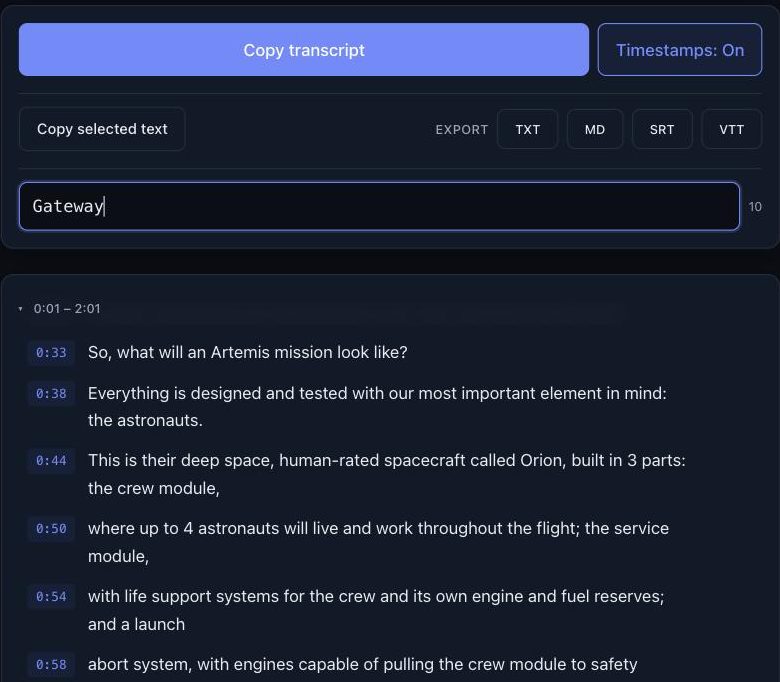
Highlight the lines you want and click Copy selected text. Only the highlighted passage is copied, exactly as the captions have it, timestamps included. Do not retype it; retyping is where words change.
Confirm them against the audio
Click the timestamp next to the first line of your quote. The embedded player jumps there. Listen through the passage once. You are checking three things: that the words are right (auto-generated captions mangle names and numbers), that the speaker did not immediately qualify or reverse the statement, and that the tone matches the way you plan to use it. A line delivered as a joke and quoted as a position is a misquote even if every word is correct.
If the captions and the audio disagree, the audio wins. Write down what was said, and note the timestamp. If a word is inaudible, mark it [inaudible] rather than guessing.
Quote, paraphrase, or summarize
Quote when the exact wording matters: a claim you are going to evaluate, a striking phrase, an admission, a definition. Paraphrase when the idea matters but the wording does not, and cite it the same way, with a timestamp. Summarize when you are describing a section of the video rather than a statement in it. Long quotations from a video are unusual and rarely necessary; a sentence or two, quoted exactly, does more work than a paragraph.
Speech is messy. It is normal practice to drop filler ("um," "you know") and false starts from a quotation, and to mark omissions with an ellipsis, as long as you do not change the meaning. Do not clean up grammar inside quotation marks; if it bothers you, paraphrase.
Cite it: the three common styles
Each style wants the same facts: who uploaded it, when, the title, the platform, the link, and, for a quotation, the timestamp. You will find the channel name and the source link at the top of every LinkTranscript export, and the upload date on the YouTube page. Examples below use a NASA video so you can compare the shapes.
APA 7. Reference list entry: the uploader, the date, the title in italics with [Video] after it, the platform, and the URL. In-text, cite the uploader and year, and add the timestamp for a quotation.
NASA. (2019, December 19). How we are going to the Moon [Video]. YouTube. https://www.youtube.com/watch?v=_T8cn2J13-4

In text: (NASA, 2019, 1:25)
MLA 9. Title in quotation marks, the platform in italics, "uploaded by" the channel, the date, and the URL. For a quotation, give the timestamp range in the in-text citation.
"How We Are Going to the Moon." YouTube, uploaded by NASA, 19 Dec. 2019, www.youtube.com/watch?v=_T8cn2J13-4.

In text: ("How We Are Going" 01:25-01:31)
Chicago (notes and bibliography). The channel as author, the title in quotation marks, "YouTube video," the running time, the date, and the URL. Put the timestamp in the note.
Note: NASA, "How We Are Going to the Moon," YouTube video, 5:31, December 19, 2019, https://www.youtube.com/watch?v=_T8cn2J13-4, at 1:25.

Bibliography: NASA. "How We Are Going to the Moon." YouTube video, 5:31. December 19, 2019. https://www.youtube.com/watch?v=_T8cn2J13-4.
Check the upload date on YouTube rather than trusting memory; it is under the video, next to the view count, and the exact day is what the styles ask for. If the person speaking is not the channel (an interview on a network's channel, say), APA and Chicago let you name the speaker in the sentence and cite the channel as the source.
Journalism and the web
Outside academic writing, the convention is simpler: name the speaker and the video in the sentence, quote exactly, and link to the timestamp. YouTube links accept a time parameter, so a link that opens at the quoted moment is the most honest citation there is; a reader can check you in one click. Take the source link from the top of the transcript page and add ?t= and the number of seconds from the timestamp (85 for a line at 1:25); if the link already contains a question mark, use &t=85 instead.
Keep a record
Videos get edited, re-uploaded, and taken down. If a quotation matters, export the transcript as TXT with timestamps on the day you cite it and keep the file with your notes. The export carries the video title, the channel, the source link, the caption language, and the date it was generated, so if the video later disappears you still have the words, the time, and where they came from. For a long project, a folder of these exports is a citation archive that takes seconds per video to build.
A short checklist
- Find the passage with search, not by scrubbing.
- Copy selected text; never retype.
- Click the timestamp and listen through the passage once.
- Drop filler, mark omissions, never change meaning.
- Cite with uploader, date, title, platform, URL, and the timestamp.
- Link to the moment when you can.
Try it on a video
Paste a YouTube link and get a clean, exportable transcript in seconds.